







Why There Are More Mice This Year — Blame the Acorns
Remember last fall? Acorns crunching underfoot, piling up in the gutters, pinging off the roof like hail. It felt like the oak trees were showing off. That wasn't just a mess to rake — it was a forecast. The mouse you're about to spot darting along a baseboard this fall was, in a sense, planted last autumn, one acorn at a time.
If it seems like there are more mice this year, and that they're arriving earlier, you're not imagining it.The short version: Last fall's oak trees had a mast year — a massive, synchronized acorn crop. Acorns are the number-one winter food for white-footed and deer mice, so far more of them survived the winter and started breeding early. Add a dry summer that stripped away their outdoor cover, and you get more mice looking for shelter, weeks ahead of schedule.
Here's the chain of events behind your bigger, earlier mouse season — and what you can do about it before the first one moves in.
What does a mast year have to do with mice?
Oak trees don't produce acorns at a steady pace. Every few years they stage what ecologists call a mast year: a huge, synchronized bumper crop that drops more acorns than every squirrel, deer, turkey, and mouse in the woods can possibly eat.
For white-footed mice and deer mice, that surplus is everything. Acorns are their number-one winter food source, and they cache the extras away like a squirrel would. A mast year is a jackpot — it lets far more mice survive the winter, and it gives the survivors a running start on breeding as soon as spring arrives.
The numbers are striking. Ecologists at the Cary Institute of Ecosystem Studies, who have tracked acorns and mice in New York's Hudson Valley for decades, have found that a lean year might support just one or two mice per acre — while the summer after a heavy mast can push that well over a hundred. That's the boom. Those extra survivors raise bigger, earlier litters, and by late summer that swollen generation is fully grown — and hunting for somewhere warm to spend the coming winter.
This year has an extra wrinkle. A dry summer thins out the tall grass, brush, and field cover that mice normally hide in. When that outdoor cover disappears early, mice lose their hiding places sooner — so they start looking for shelter sooner, too. More mice, and less patience about coming indoors. That's why a mouse infestation this season is landing bigger and earlier.
Why are mice suddenly showing up at my house?
There are really two answers, and most homes feel at least one of them.
The first is the rural-to-suburban bridge. Country homes, farmhouses, barns, sheds, cabins, and campers all sit right on the mouse highway — and so does the truck parked at the edge of a field, the tractor in the open shed, and the RV winterized out back. Anything close to woods, pasture, or overgrown edges is a natural first stop for mouse acitvity when the population outgrows the tree line. This year, with the boom in full swing, that traffic is heavier than usual.
The second driver is universal, and it doesn't care whether you live on forty acres or a tidy cul-de-sac: the first cool night. When overnight temperatures drop, every mouse within range starts testing foundations, door sweeps, and dryer vents for an entry point. And they don't need much — a gap about the width of a pencil is enough to let one through. So even a buttoned-up suburban house gets a knock this time of year. This fall, that knock is just louder and a few weeks earlier.
How do you know if mice are already inside?
Mice are quiet tenants at first. They usually leave evidence before you ever see one, so it's worth knowing what signs of a mouse problem to look for.
- Droppings. Small, dark, and about the size of a grain of rice, usually clustered along walls, in the back of cabinets, or in silverware drawers. Fresh ones are dark and soft; old ones are gray and crumble.
- Gnaw marks. Chewed corners on cardboard boxes, cereal bags, dog food sacks. Mice also work on soft plastic, wiring insulation, and the edges of wood trim.
- Nesting material. Shredded paper, fabric, insulation, or dryer lint tucked into a quiet corner —behind the water heater, inside a stored boot, in the glove box of the truck.
- Sounds at night. Scratching, scurrying, or faint squeaking inside walls and ceilings after dark, when the house goes quiet.
- Greasy rub marks. Mice travel the same routes along baseboards and pipes, and the oil in their fur leaves a faint dark smudge over time.
- A musky smell. Urine has a sharp ammonia note that builds in enclosed spaces — closets, cabinets, a camper that's been shut up for a few weeks.
- Your pets know first. A dog or cat suddenly fixated on the space under the stove or behind the dryer is usually right.
If you're seeing any of these, you're past prevention and into removal — and the pouches are best used after that to keep the space from being reclaimed.
How do you keep mice out without poison?
The reflex is to reach for snap traps and bait. But bait means a dead mouse somewhere in a wall or duct, an eventual smell, and cleanup — plus poison sitting around where kids and pets roam. Traps mean the same body count, one at a time. Prevention is the smarter play: make the space unwelcoming before you're finding droppings, not after.
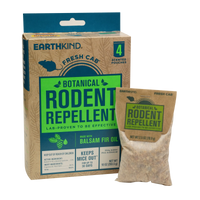
That's where Fresh Cab Botanical Rodent Repellent comes in. Fresh Cab is an EPA-registered botanical rodent repellent — registered specifically for repelling mice — powered by balsam fir oil and made from plant fibers and essential oils. Instead of killing mice, it repels them, so there are no traps to set and no mess to clean up. It's made in the USA, has protected homes, cabins, farms, and RVs since 2007, and is safe for use in homes with children and pets when used as directed.
The key word is prevention. Tuck the pouches into the places mice head for first, at the start of the season, and you're deterring them before they ever settle in.
Where to shop and where to place it
You can shop Fresh Cab directly at earthkind.com or find it on Amazon. Both carry the same EPA-registered botanical formula.
For prevention in a space you haven't seen mouse activity in yet, use about one pouch per 125 square feet, and replace every 30 days or when the balsam scent fades. A quick placement checklist for this time of year:
- Garage and shed — set pouches in the corners and along the walls
- Kitchen and pantry — under and behind cabinets, near stored food
- Attic, crawl space and basement — the quiet, undisturbed spots mice love
- Stored RVs, campers, and boats — under seats, in storage bays, and near the engine before you winterize
- The truck, tractor, or equipment parked by the field — the classic first target
- Barns and outbuildings — feed rooms, tack trunks, and grain storage
Last fall's acorns already set this season in motion. The good news is that the mouse part of the story is the one you actually get to write. Get ahead of the first cool night, and you can skip the traps entirely.


