


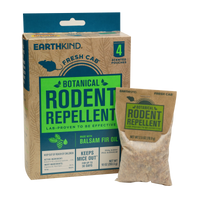



Bill Dillon of Plum Creek Kennels uses Fresh Cab in his kennel and RV 12 months a year to prevent rat and mouse infestations without fail. Bill’s mouse repellant tip: place the pouch in a hanging suet cage off the floor to allow for easy spray-downs without having to move pouches daily.
The demand for methods to control rodents effectively in “green” ways can challenge or frustrate dog kennel owners. These pests are nearly unstoppable. Mice can survive and reproduce in temperatures as low as 24 degrees if they have adequate food and nesting space.
All of this means that dog kennel owners and homeowners with pets need a reliable rodent control product. Fresh Cab is a bio-pesticide rodent repellent registered by the EPA for use indoors and in enclosed areas. These pouches use a mix of essential oils and other plant-based ingredients to create a scent that will overwhelm a rodent’s sense of smell, causing them to leave the area. The pouches are safe to use around pets when used as directed.
Along with finding a reliable repellent and understanding how to use it in these areas, knowing the five structural areas most vulnerable to rodents can help dog kennel owners win the rodent battle in even the hardest-to-control situations.
Five Areas to Check for Mice in Dog Kennels
1. Drop ceilings. Mice and rats love dark areas where they can live undetected. Ceiling crawl spaces and drop ceilings are hard for humans to get to, which makes it hard to monitor and control rodents. Fresh Cab pouches effectively keep rodents out of these areas for a month or more—or can be used to chase mice and rats into another area where they can be successfully trapped or baited.
2. Meters and electrical panels. In almost any business, rodents seek out meters and panels as points of entry, nesting sites, and places to cool down or warm up. They also love to gnaw on wiring. Check around water meters, electrical panels, junction boxes, and wiring harnesses. Pay particular attention to hollow blocks or transformers near electrical panels, which may serve as nesting sites.
 3. Utility lines. Rodents have sharp claws, are great climbers, and love to climb and run along electric wires, pipes, poles, ropes, cables, conduits, augers, conveyors, and even underground utility and communication lines. A kennel owner controlling the rodents who can “read the building lines” has a powerful tool, and Fresh Cab pouches are highly effective when placed where it will disrupt a scent trail.
4. Pallet racks. Pallet racks and partially capped upright beams in warehouses and distribution centers can be a superhighway for rodents, allowing them to come and go almost undetected. Many facilities see excellent results from integrating pest management methods with perimeter trapping, bait stations, and Fresh Cab pouches placed on or near pallets.
5. Holes. Pest management professionals doing an inspection should always assume that the structure has changed or deteriorated since the last inspection. Construction defects, gaps in fascia board, and poorly caulked entrance areas around wires and vents lead to rodent infestations. (By the way, caulk and expandable foam are fillers but are not sealers and will not stop rodents from entering.) “Stopping rodents at the hole” can keep a business mouse-free and is the ultimate “green” solution.


